Artificial Intelligence is rapidly evolving from simple automation to autonomous decision-making systems. Today's enterprises are looking for AI solutions that can understand business data, reason through complex tasks, and take intelligent actions with minimal human intervention. This new generation of AI is known as Agentic AI.
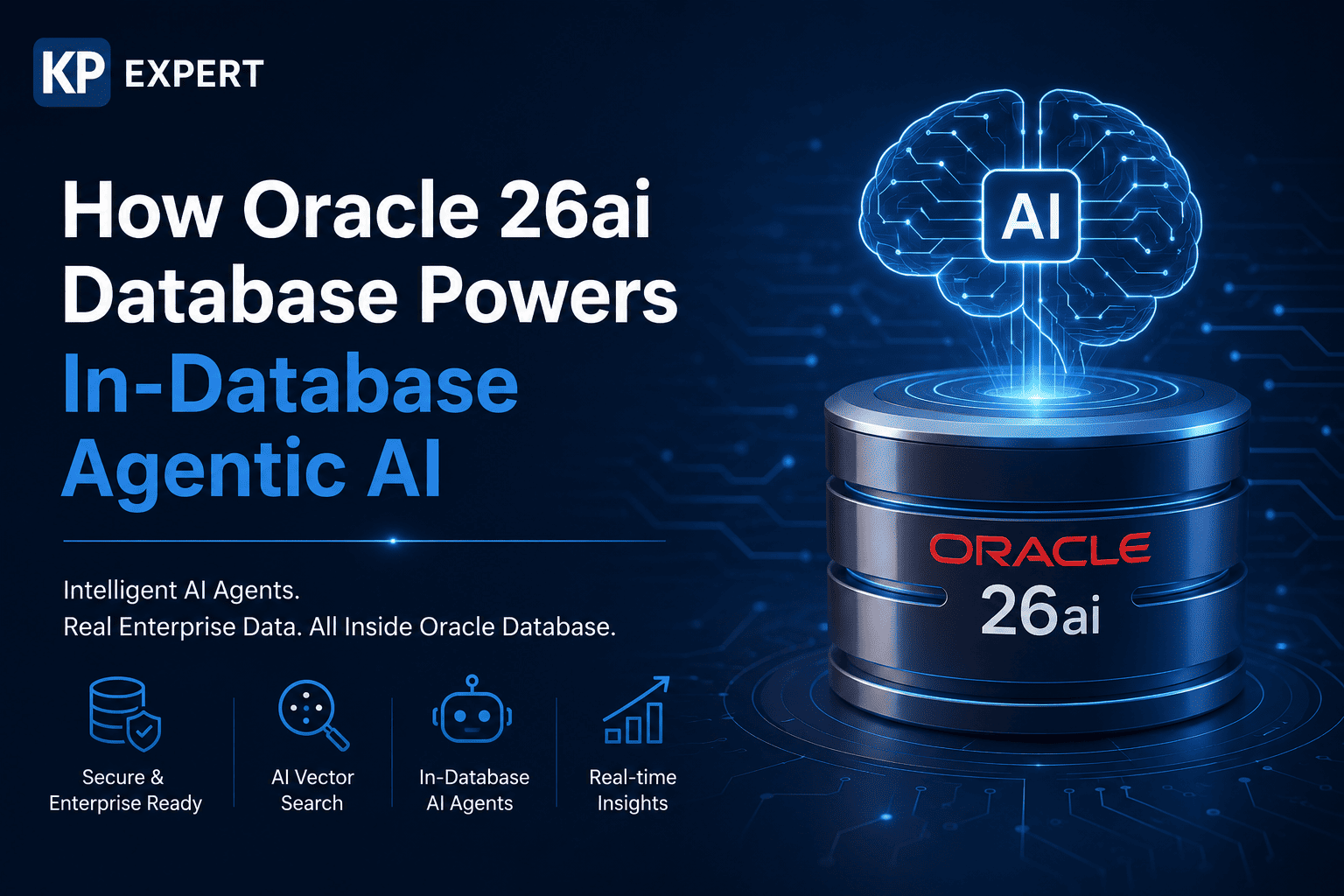
Oracle has introduced Oracle Database 26ai, a major advancement that brings In-Database Agentic AI capabilities directly into the database. Instead of moving enterprise data between multiple AI platforms, organizations can now build, deploy, and manage intelligent AI agents where their data already resides.
By combining Oracle AI Vector Search, Retrieval-Augmented Generation (RAG), enterprise-grade security, SQL, PL/SQL, and Oracle's high-performance database engine, Oracle 26ai provides a unified platform for developing secure, scalable, and production-ready AI applications.
In this article, you'll learn how Oracle 26ai powers In-Database Agentic AI, its architecture, core features, enterprise use cases, and why it represents a significant shift in enterprise AI development.
What Is Oracle Database 26ai?
Oracle Database 26ai is Oracle's latest AI-enabled database platform designed to help organizations build intelligent applications without moving data outside the database.
Unlike traditional AI architectures that depend on multiple external services, Oracle 26ai integrates AI capabilities directly into the database engine. Developers can perform vector search, semantic search, retrieval-augmented generation, natural language processing, and autonomous AI workflows using the same Oracle Database platform they already trust.
The database becomes more than a storage system—it becomes an intelligent execution environment capable of supporting enterprise AI workloads.
Key capabilities include:
- Oracle AI Vector Search
- In-Database Agentic AI
- Retrieval-Augmented Generation (RAG)
- AI-assisted SQL development
- Native vector data types
- Enterprise security and governance
- High-performance AI inference
- Integration with Large Language Models (LLMs)
What Is In-Database Agentic AI?
In-Database Agentic AI allows autonomous AI agents to execute tasks, retrieve enterprise knowledge, make decisions, and interact with business applications—all without moving data outside the Oracle Database.
Unlike traditional chatbots that simply answer questions, Agentic AI can:
- Understand business goals
- Plan multi-step actions
- Retrieve relevant enterprise information
- Execute SQL queries
- Interact with Oracle applications
- Validate results
- Continue workflows automatically
Because these agents operate inside Oracle Database, they have secure, governed access to enterprise data while benefiting from Oracle's transaction management, auditing, and access controls.
Why Traditional AI Architecture Falls Short
Many organizations currently use a workflow similar to this:
- Export data from Oracle Database.
- Store embeddings in a separate vector database.
- Send user queries to an external AI service.
- Retrieve relevant documents.
- Generate an AI response.
- Return the response to the application.
This approach introduces several challenges:
- Multiple data copies
- Higher latency
- Increased infrastructure costs
- Security risks
- Complex integrations
- Data synchronization issues
- Compliance challenges
Managing separate AI platforms, vector databases, APIs, and orchestration tools can become expensive and difficult to maintain.
Oracle 26ai Changes the Enterprise AI Architecture
Oracle 26ai eliminates many of these challenges by bringing AI directly into the database. Instead of sending enterprise data across multiple systems, Oracle enables AI processing where the data already exists.
The architecture becomes significantly simpler:
This streamlined approach reduces latency, improves security, simplifies governance, and accelerates AI application development.
Core Components of Oracle 26ai In-Database Agentic AI
Oracle combines several AI technologies into a single platform.
1. AI Agents
AI agents understand requests, break down tasks into logical steps, execute actions, and return accurate responses.
They can:
- Plan workflows
- Call SQL procedures
- Access enterprise knowledge
- Generate reports
- Automate repetitive business operations
2. Oracle AI Vector Search
Oracle AI Vector Search allows semantic search over enterprise documents. Instead of matching exact keywords, the database understands the meaning behind user queries.
For example:
| Search Type | Example Query |
|---|---|
| Traditional Search | Find documents containing "customer refund policy" |
| Vector Search | "How can I return a damaged product?" |
Even if the exact words differ, Oracle identifies semantically similar information. This dramatically improves search accuracy for enterprise AI assistants.
3. Retrieval-Augmented Generation (RAG)
Oracle 26ai integrates Retrieval-Augmented Generation directly into database workflows. Instead of relying only on an LLM's training data, Oracle retrieves the most relevant enterprise documents before generating a response.
Benefits include:
- More accurate answers
- Reduced hallucinations
- Real-time enterprise knowledge
- Domain-specific intelligence
- Better compliance
4. Native Vector Data Type
Oracle Database 26ai supports vector data natively. Developers no longer need separate vector databases.
This allows:
- Faster similarity searches
- Efficient embedding storage
- Simplified architecture
- Better scalability
- Lower infrastructure costs
5. Enterprise Security
One of Oracle's biggest advantages is enterprise-grade security. AI agents automatically inherit Oracle Database security features, including:
- Role-based access control
- Database auditing
- Encryption
- Fine-grained authorization
- Data governance
- Compliance policies
This ensures AI applications remain secure while accessing sensitive enterprise information.
Key Features of Oracle 26ai In-Database Agentic AI
| Feature | Benefit |
|---|---|
| In-Database Agentic AI | AI agents execute tasks where enterprise data resides |
| Oracle AI Vector Search | Semantic search across enterprise knowledge |
| Native Vector Storage | No external vector database required |
| Retrieval-Augmented Generation | Accurate, context-aware AI responses |
| Enterprise Security | Built-in governance and compliance |
| SQL Integration | AI agents interact directly with Oracle Database |
| Scalable Architecture | Supports enterprise-scale AI workloads |
| High Performance | Reduced latency and faster AI processing |
Why Enterprises Are Adopting Oracle 26ai
Organizations across industries are exploring Agentic AI to automate complex workflows while maintaining control over sensitive data. Oracle 26ai provides a practical path by combining AI capabilities with the reliability of Oracle Database.
Some of the key business drivers include:
- Faster AI application development
- Reduced infrastructure complexity
- Lower operational costs
- Improved data security
- Better governance and compliance
- Real-time access to enterprise data
- Higher accuracy through Retrieval-Augmented Generation (RAG)
- Simplified management with a unified database platform
As enterprises continue investing in AI, Oracle 26ai enables them to build intelligent applications without introducing unnecessary architectural complexity.
Oracle 26ai In-Database Agentic AI Architecture
Oracle 26ai combines multiple AI technologies into a unified architecture, allowing developers to build intelligent applications without relying on separate vector databases or complex AI orchestration platforms.
High-Level Architecture
Unlike traditional AI systems, enterprise data remains inside Oracle Database throughout the process, reducing latency and improving security.
How In-Database Agentic AI Works
An AI agent inside Oracle Database follows a structured workflow to answer questions or perform business tasks.
Step 1: Receive a User Request
A user submits a query through an enterprise application, such as:
- "Show pending invoices over ₹5 lakh."
- "Summarize this customer's purchase history."
- "Generate this month's sales report."
- "Identify high-risk insurance claims."
The request is sent directly to Oracle Database 26ai.
Step 2: Understand the Intent
The AI agent interprets the request using natural language processing and identifies:
- User intent
- Required data
- Business rules
- Relevant database objects
- Required actions
This enables the agent to create a plan instead of executing a single query.
Step 3: Retrieve Enterprise Knowledge
The agent uses Oracle AI Vector Search to locate relevant information, including:
- Knowledge base articles
- Product documentation
- Customer records
- Internal policies
- Contracts
- Technical manuals
- Historical reports
Because Vector Search is semantic, the system retrieves information based on meaning rather than exact keyword matches.
Step 4: Execute Database Operations
The AI agent can perform database tasks such as:
- Running SQL queries
- Calling PL/SQL procedures
- Accessing stored business logic
- Validating permissions
- Aggregating data
- Generating analytics
All operations are executed within Oracle Database, eliminating unnecessary data movement.
Step 5: Generate an Intelligent Response
After retrieving enterprise data, Oracle 26ai combines it with an LLM using Retrieval-Augmented Generation (RAG). The result is a response that is:
- Accurate
- Context-aware
- Up to date
- Based on enterprise data
- Secure and compliant
AI Agent Lifecycle in Oracle Database 26ai
Oracle AI agents operate through a continuous lifecycle.
1. Understand
The agent interprets the user's objective. Example: "Prepare a weekly sales summary."
2. Plan
The agent determines the required steps. For example:
- Retrieve sales data
- Compare weekly performance
- Identify top-selling products
- Generate charts
- Summarize findings
3. Retrieve
The AI agent searches:
- Structured tables
- Vector indexes
- Documents
- Knowledge repositories
- Business policies
4. Execute
The agent performs tasks such as:
- SQL execution
- Analytics
- Data transformation
- Report generation
- API integration
5. Validate
Oracle security policies ensure:
- Authorized data access
- Compliance checks
- Role validation
- Audit logging
6. Respond
The AI generates a natural-language response or completes the requested business action.
Oracle AI Vector Search in Action
Traditional SQL searches require exact matches. For example:
However, users may ask: "How do I send back a damaged product?"
Traditional keyword searches may fail because the wording differs. Oracle AI Vector Search understands semantic similarity and retrieves the correct policy document, improving search accuracy.
This capability is particularly valuable for:
- Customer support
- Enterprise search
- HR knowledge portals
- Healthcare documentation
- Legal research
Retrieval-Augmented Generation (RAG) in Oracle 26ai
One of Oracle 26ai's standout capabilities is its native support for Retrieval-Augmented Generation (RAG). Without RAG, an LLM relies solely on its training data, which can lead to outdated or inaccurate responses.
With Oracle 26ai:
- The AI agent receives a query.
- Oracle AI Vector Search retrieves relevant enterprise information.
- The LLM receives this context.
- The response is generated using current business data.
Benefits of RAG
- Higher accuracy
- Reduced AI hallucinations
- Domain-specific knowledge
- Real-time enterprise information
- More trustworthy responses
Built-in Enterprise Security
Oracle has designed In-Database Agentic AI with enterprise security at its core. Key security capabilities include:
- Role-Based Access Control (RBAC): AI agents access only authorized data.
- Data Encryption: Protects data both at rest and in transit.
- Fine-Grained Access Control: Restricts access to sensitive records.
- Audit Logging: Tracks every AI interaction for compliance.
- Governance Policies: Ensures AI follows organizational and regulatory requirements.
These features help organizations deploy AI while maintaining strict control over sensitive information.
Benefits of Running AI Agents Inside Oracle Database
Compared to traditional AI architectures, Oracle 26ai offers several operational advantages:
| Traditional AI Platform | Oracle Database 26ai |
|---|---|
| Multiple AI services | Unified AI platform |
| External vector database | Native vector storage |
| Data movement | Data remains in the database |
| Complex integrations | Simplified architecture |
| Higher latency | Faster response times |
| Separate security controls | Built-in Oracle security |
| Increased operational costs | Reduced infrastructure costs |
Real-World Example
Consider a global retail company that wants an AI assistant to answer inventory-related questions. Instead of exporting data to multiple AI tools, Oracle 26ai allows the AI agent to:
- Access inventory tables
- Search supplier agreements
- Review warehouse documents
- Check purchase orders
- Analyze historical sales
- Generate recommendations
All of these actions occur within Oracle Database, providing faster responses while keeping business data secure.
Enterprise Use Cases of Oracle 26ai In-Database Agentic AI
Oracle 26ai enables organizations to build intelligent AI agents that automate business processes while maintaining enterprise-grade security and governance.
1. Financial Services
Banks and financial institutions manage large volumes of sensitive data, making security and compliance critical. With Oracle 26ai, AI agents can:
- Analyze customer transactions
- Detect suspicious activities
- Generate financial summaries
- Assist loan approval processes
- Provide investment insights
- Retrieve regulatory documents
Example: A relationship manager asks: "Show all customers whose loan repayments have been delayed by more than 30 days." The AI agent retrieves customer records, checks repayment history, applies business rules, and returns an accurate report in seconds.
2. Healthcare
Healthcare providers store patient records, treatment histories, insurance information, and medical research. Oracle 26ai enables AI agents to:
- Search electronic health records
- Summarize patient history
- Retrieve treatment guidelines
- Assist medical researchers
- Generate discharge summaries
- Improve clinical decision support
Because patient information remains inside Oracle Database, organizations can better protect sensitive healthcare data.
3. Retail and E-Commerce
Retail companies generate vast amounts of product, inventory, customer, and order data. AI agents can help by:
- Recommending products
- Answering customer queries
- Managing inventory
- Forecasting demand
- Tracking shipments
- Generating sales reports
Example: A manager asks: "Which products experienced the highest sales growth this month?" The AI agent analyzes transactional data, compares historical sales, and generates a detailed report without exporting data to external AI systems.
4. Manufacturing
Manufacturers can use Oracle 26ai to optimize operations across production facilities. AI agents assist with:
- Predictive maintenance
- Equipment monitoring
- Quality assurance
- Supply chain analysis
- Production scheduling
- Inventory optimization
The ability to analyze operational data within the database helps reduce downtime and improve efficiency.
5. Human Resources
HR departments manage employee records, payroll, training, and recruitment data. Oracle AI agents can:
- Answer HR policy questions
- Summarize employee profiles
- Recommend training programs
- Screen resumes
- Generate workforce reports
- Assist onboarding processes
Employees receive accurate answers based on current organizational policies stored within Oracle Database.
Oracle AI Vector Search + RAG for Enterprise Knowledge
Many organizations maintain large repositories of:
- Policy documents
- Contracts
- Technical manuals
- Knowledge base articles
- Product documentation
- Standard operating procedures
- Customer support records
Oracle AI Vector Search enables semantic retrieval across these documents. When combined with Retrieval-Augmented Generation (RAG), AI agents deliver responses grounded in the latest enterprise information rather than relying solely on a language model's training data.
Example: An employee asks: "What is our travel reimbursement policy for international business trips?" The AI agent searches policy documents using Vector Search, retrieves the most relevant sections, passes the context to the LLM, and generates an accurate, policy-based answer.
This approach improves accuracy and reduces the risk of incorrect or outdated responses.
Benefits of Oracle 26ai In-Database Agentic AI
Organizations adopting Oracle 26ai can realize several operational and strategic benefits.
✅ Improved Data Security
Enterprise data stays within Oracle Database, reducing the need to move sensitive information across multiple platforms.
✅ Lower Infrastructure Complexity
Native support for AI capabilities eliminates the need for separate vector databases and complex integration layers.
✅ Faster AI Responses
By processing AI workflows inside the database, Oracle reduces latency and improves application performance.
✅ Better Governance
Oracle's security features, auditing, and access controls help organizations maintain compliance with internal policies and regulatory requirements.
✅ Scalable AI Applications
Oracle Database is designed to handle enterprise-scale workloads, enabling organizations to deploy AI applications across departments and business units.
Oracle 26ai vs Traditional Enterprise AI Architecture
| Capability | Traditional AI Stack | Oracle Database 26ai |
|---|---|---|
| Data Storage | Separate databases | Unified Oracle Database |
| Vector Search | External vector database | Native AI Vector Search |
| AI Agents | External orchestration | In-Database Agentic AI |
| Data Security | Multiple security layers | Built-in Oracle security |
| Data Movement | Frequent data transfer | Data remains in the database |
| Maintenance | Multiple platforms | Simplified management |
| Performance | Higher latency | Faster processing |
Why Enterprises Prefer In-Database Agentic AI
Running AI agents directly within Oracle Database offers several practical advantages:
- Reduced operational overhead
- Simplified AI deployment
- Stronger data governance
- Faster access to enterprise knowledge
- Lower integration effort
- Consistent security policies
- Better scalability for production workloads
These advantages make Oracle 26ai a compelling platform for organizations looking to build secure and reliable AI-powered enterprise applications.
Best Practices for Implementing Oracle 26ai In-Database Agentic AI
To maximize the value of Oracle 26ai, consider the following practices:
- Organize enterprise knowledge for effective Vector Search.
- Keep documents and structured data updated to improve RAG accuracy.
- Apply role-based access controls to AI agents.
- Monitor AI activity through Oracle auditing features.
- Optimize SQL queries and vector indexes for performance.
- Validate AI-generated responses before automating critical business processes.
- Establish governance policies for AI development and deployment.
Performance and Scalability
Oracle Database has long been recognized for its performance in enterprise environments. Oracle 26ai extends these strengths by integrating AI capabilities into the database engine.
Organizations benefit from:
- High-performance vector search
- Efficient handling of large datasets
- Reduced network overhead
- Scalable AI workloads
- Support for mission-critical enterprise applications
This combination enables businesses to deploy AI solutions that can grow alongside their operational needs.
Future of Enterprise AI with Oracle Database 26ai
Artificial Intelligence is moving beyond simple question-answering systems toward autonomous software agents capable of planning, reasoning, and executing complex business workflows.
Oracle Database 26ai provides a strong foundation for this evolution by combining enterprise data management with AI capabilities in a single platform.
Future enterprise AI applications are expected to:
- Automate multi-step business processes.
- Improve enterprise search with semantic understanding.
- Deliver context-aware decision support.
- Assist developers with AI-powered coding and database operations.
- Enable secure AI adoption across regulated industries.
As organizations continue modernizing their technology stacks, In-Database Agentic AI can help simplify deployment while maintaining performance, governance, and compliance.
Why Oracle Database 26ai Matters
Oracle Database 26ai represents an important advancement in enterprise AI by reducing the gap between data storage and AI execution. Instead of exporting data to multiple platforms, businesses can build intelligent applications where their data already resides.
Key advantages include:
- Native AI capabilities within Oracle Database
- Oracle AI Vector Search for semantic retrieval
- Retrieval-Augmented Generation (RAG) integration
- Reduced infrastructure complexity
- Faster AI response times
- Enterprise-grade security and governance
- Native vector storage
- Support for autonomous AI agents
- Simplified AI application development
- Scalability for enterprise workloads
These capabilities make Oracle Database 26ai a practical platform for organizations seeking to implement AI while maintaining control over their enterprise data.
Conclusion
Oracle Database 26ai introduces a new approach to enterprise AI by embedding intelligent agent capabilities directly into the database. Through In-Database Agentic AI, Oracle AI Vector Search, native vector storage, and Retrieval-Augmented Generation (RAG), organizations can build secure, scalable, and context-aware AI applications without relying on complex external architectures.
By keeping enterprise data within Oracle Database, businesses can improve security, reduce latency, simplify infrastructure, and deliver more accurate AI-driven experiences. Whether you're developing AI-powered customer support systems, enterprise search, financial analytics, or workflow automation, Oracle Database 26ai provides the tools needed to create production-ready AI solutions.
As AI adoption accelerates across industries, Oracle Database 26ai positions itself as a unified platform for organizations looking to combine trusted data management with advanced AI capabilities.
Frequently Asked Questions (FAQs)
1. What is In-Database Agentic AI in Oracle 26ai?
In-Database Agentic AI is a capability in Oracle Database 26ai that enables AI agents to understand user requests, retrieve enterprise knowledge, execute database operations, and generate intelligent responses without moving data outside the database.
2. How is In-Database Agentic AI different from traditional AI applications?
Traditional AI applications often rely on multiple external services, including vector databases, orchestration platforms, and APIs. Oracle Database 26ai integrates AI capabilities directly into the database, reducing architectural complexity, improving security, and minimizing data movement.
3. What is Oracle AI Vector Search?
Oracle AI Vector Search enables semantic search by comparing the meaning of data instead of exact keywords. It helps AI agents retrieve relevant enterprise documents, records, and knowledge even when the wording of a query differs from the stored content.
4. Does Oracle Database 26ai support Retrieval-Augmented Generation (RAG)?
Yes. Oracle Database 26ai integrates Retrieval-Augmented Generation (RAG) with Oracle AI Vector Search. AI agents retrieve relevant enterprise information before sending context to a Large Language Model (LLM), improving the accuracy and reliability of AI-generated responses.
5. Which industries can benefit from Oracle 26ai In-Database Agentic AI?
Oracle Database 26ai is suitable for many industries, including:
- Banking and Financial Services
- Healthcare
- Retail and E-commerce
- Manufacturing
- Telecommunications
- Insurance
- Government
- Human Resources
- Education
- Logistics
6. Is Oracle 26ai secure for enterprise AI applications?
Yes. Oracle Database 26ai leverages existing Oracle security features such as:
- Role-Based Access Control (RBAC)
- Database auditing
- Data encryption
- Fine-Grained Access Control (FGAC)
- Oracle Database Vault
- Enterprise governance policies
These capabilities help organizations build AI applications while protecting sensitive business data.
7. Can Oracle 26ai integrate with Large Language Models (LLMs)?
Yes. Oracle Database 26ai is designed to work with Large Language Models by providing enterprise data through Retrieval-Augmented Generation (RAG). This allows organizations to build intelligent applications that combine LLM capabilities with real-time business information.