Introduction
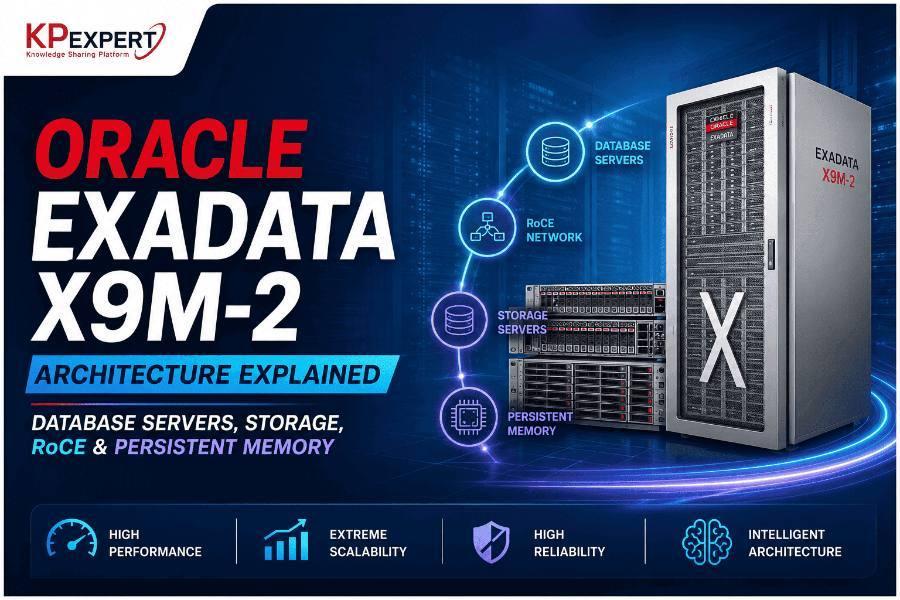
Oracle Exadata X9M-2 is an engineered database platform designed to combine database compute, intelligent storage, high-speed networking, and specialized Exadata System Software into a single integrated architecture.
Unlike a conventional database environment where database servers depend on general-purpose external storage, Exadata distributes processing across database servers and intelligent storage servers. A high-speed internal RDMA Network Fabric connects these components, allowing database I/O to move efficiently between compute and storage resources.
The X9M generation is particularly important because it introduced a 100 Gb/s RDMA over Converged Ethernet (RoCE) fabric, PCIe 4.0-based components, and persistent-memory acceleration. These technologies work together to reduce I/O latency, increase throughput, and support demanding Oracle Database workloads.
This article provides a technical overview of Oracle Exadata X9M-2 architecture, including database servers, storage servers, RoCE networking, RDMA, persistent memory, Flash Cache, Smart Scan, ASM, I/O flow, scalability, and high availability.
What Is Oracle Exadata X9M-2?
Oracle Exadata X9M-2 is a scale-out engineered system consisting of database servers, intelligent storage servers, high-speed RoCE network switches, and management infrastructure.
Oracle's documented X9M-2 fixed configuration includes:
- 2 X9M-2 database servers
- 3 X9M-2 storage servers
- 2 RoCE Network Fabric switches
- 1 management network switch
- Redundant power distribution units
- Persistent memory in the storage servers
- PCIe flash storage
- High-capacity disk storage, depending on the storage-server configuration
The architecture can also scale by adding database and storage servers, allowing organizations to increase compute and storage resources independently within supported configurations. Oracle's X9M-2 documentation describes configurations ranging from smaller systems to large rack-scale deployments.
Oracle Exadata X9M-2 Architecture at a Glance
A simplified view of the architecture is:
This architecture separates database processing from storage processing while connecting both through a high-speed RDMA fabric.
Key Components of Exadata X9M-2
The major architectural components are:
- Database Servers
- Storage Servers
- RoCE Network Fabric
- RoCE Switches
- Persistent Memory
- PCIe Flash
- Hard-Disk Storage
- CELLSRV and Exadata System Software
- Oracle ASM
- Database and storage networking
Each component has a specific role, but the performance advantages of Exadata come from how these components operate together.
Exadata X9M-2 Database Server Architecture
The database servers provide the primary compute resources for Oracle Database workloads. They run components such as:
- Oracle Database
- Oracle Grid Infrastructure
- Oracle ASM
- Oracle Clusterware
- Operating-system services
- Exadata System Software components
The database servers process SQL, manage database sessions, execute query plans, maintain database structures, and coordinate I/O with the storage servers.
In a fixed X9M-2 eighth-rack configuration, Oracle documents two database servers, each with one 32-core processor with all 32 cores enabled. Larger configurations can contain additional database servers.
The important architectural point is that database servers do not have to perform every operation associated with retrieving and filtering data. Eligible operations can be offloaded to the intelligent storage layer.
Exadata X9M-2 Storage Server Architecture
The storage server is one of the most important differences between Exadata and conventional storage platforms.
An X9M-2 High Capacity storage server includes processors, memory, hard disks, PCIe NVMe flash devices, persistent memory, system storage, and a high-speed RDMA network interface. Oracle's current documentation specifies two 16-core Intel Xeon processors, 12 × 18 TB HDDs in the full HC configuration, four 6.4 TB PCIe 4.0 NVMe flash devices, and 12 × 128 GB persistent-memory modules. Eighth-rack configurations use fewer enabled storage devices.
The storage server also runs Exadata System Software, including the services responsible for intelligent storage processing.
A simplified storage-server architecture is:
This design allows storage resources to participate in database processing rather than functioning as passive block-storage devices.
What Is CELLSRV in Exadata X9M-2?
CELLSRV, or Cell Server, is the central storage-server software component responsible for many Exadata storage services. It participates in capabilities such as:
- Smart I/O
- SQL offload
- Storage Index processing
- I/O Resource Management
- Flash Cache services
- Persistent-memory-related acceleration
- Storage access
The architecture therefore extends beyond:
and becomes:
This database-aware storage model is one of the defining characteristics of Exadata.
X9M-2 RoCE Network Architecture
One of the most significant architectural features of X9M-2 is its 100 Gb/s RDMA over Converged Ethernet (RoCE) internal fabric.
Oracle's X9M-2 data sheet identifies the internal fabric as 100 Gb/s RoCE and describes it as the network connecting the database and storage servers.
A simplified topology is:
The redundant fabric provides multiple paths between database and storage resources. Oracle's documented X9M-2 rack configuration includes two RoCE Network Fabric switches.
What Is RoCE?
RoCE stands for RDMA over Converged Ethernet. It allows RDMA communication to operate over an Ethernet-based network. RDMA enables systems to transfer data directly between memory regions with reduced involvement from the traditional operating-system networking stack and CPU processing.
Oracle explains that RDMA can allow computers to exchange data in main memory without involving the processor, cache, or operating system in the conventional way, while RoCE provides RDMA over Ethernet. For Exadata, this technology provides a high-speed communication path between database servers and storage servers.
Why RDMA Matters in Exadata
Database workloads can generate substantial I/O traffic. Traditional networking can introduce CPU and software-stack overhead when moving data between systems. RDMA is designed to reduce that overhead.
A simplified traditional model is:
An RDMA-based model can be represented as:
This helps reduce communication latency and CPU overhead. In X9M-2, RDMA is integrated into the network fabric and storage architecture rather than being treated as an isolated networking feature.
Persistent Memory in Exadata X9M-2
Persistent Memory, commonly abbreviated as PMEM, is a major component of X9M-2 storage architecture. X9M-2 storage servers use persistent-memory modules to provide a very low-latency caching tier.
Oracle's documentation identifies PMEM as part of the X9M-2 storage-server architecture and describes the Persistent Memory Data Accelerator as using PMEM as a cache in front of Flash Cache.
In the X9M-2 fixed configuration, each storage server contains 768 GB of persistent memory, giving the documented eighth-rack configuration 2.3 TB of raw PMEM capacity across three storage servers.
How Exadata Persistent Memory Works
The PMEM architecture can be simplified as:
The important point is that PMEM is used as an acceleration layer rather than simply replacing all other storage.
Oracle describes the Persistent Memory Data Accelerator as placing a PMEM cache in front of Flash Cache. RDMA provides direct access to remote persistent memory, reducing read latency. This architecture allows frequently accessed data to benefit from a much faster storage-access path.
X9M-2 Flash Architecture
Flash is another important performance layer. The X9M-2 High Capacity storage server uses PCIe NVMe flash devices. Oracle specifies four 6.4 TB PCIe 4.0 flash devices for a full HC storage-server configuration, with fewer devices in the eighth-rack configuration.
Flash can serve frequently accessed database data much faster than traditional hard disks. Exadata's Smart Flash Cache automatically caches suitable database objects in flash to reduce access to slower storage media.
The resulting storage hierarchy can be viewed as:
The actual data placement and caching behavior are managed by Exadata software rather than requiring DBAs to manually manage individual blocks between tiers.
X9M-2 Hard-Disk Storage
High Capacity X9M-2 storage servers combine flash and hard-disk storage. Oracle documents 12 × 18 TB HDDs for a full High Capacity X9M-2 storage server, while eighth-rack configurations use six HDDs.
Hard disks provide high storage capacity at a lower cost per TB than flash or PMEM. Exadata therefore uses multiple storage technologies to balance:
- Capacity
- Cost
- Latency
- Throughput
- I/O performance
Oracle ASM and Exadata X9M-2 Storage
Oracle Automatic Storage Management (ASM) provides the storage-management layer for Oracle Database. At a simplified level:
ASM distributes database storage across available Exadata storage resources. This scale-out approach helps Oracle Database use multiple storage servers concurrently.
In Exadata cloud infrastructure, Oracle documentation describes ASM as provisioning storage space inside Exadata storage servers when a VM cluster is provisioned.
How Database I/O Flows Through X9M-2
The complete I/O path is one of the most important concepts when learning Exadata architecture. A simplified flow is:
- Application sends SQL
- Oracle Database parses SQL
- Optimizer creates execution plan
- Database determines I/O requirements
- Smart I/O request generated
- Request travels through RoCE/RDMA fabric
- Storage Server receives request
- CELLSRV processes request
- Storage Index / cache mechanisms evaluated
- PMEM / Flash / Disk accessed
- Eligible SQL processing occurs at storage
- Relevant data returned to DB Server
- Database completes remaining processing
- Result returned to application
This is fundamentally different from a model in which the database server retrieves every underlying block and performs all filtering locally.
Smart Scan in Exadata X9M-2
Smart Scan is one of Exadata's most important database offload technologies. With eligible SQL operations, Exadata can move selected processing to the storage servers. For example:
Instead of unnecessarily transferring all qualifying database blocks to the database server, Exadata can perform eligible filtering at the storage layer. The conceptual flow is:
This can reduce:
- Network traffic
- Database-server CPU work
- Storage I/O
- Data movement
- Query processing time for suitable workloads
Storage Indexes in X9M-2
Storage Indexes are another important Exadata optimization. A Storage Index maintains metadata about data in storage regions, including information such as minimum and maximum values.
For example, assume a region contains:
If a query requests:
the storage server can determine that the region cannot satisfy the predicate and avoid unnecessary I/O.
Oracle states that Storage Indexes help Exadata avoid unnecessary I/O and are automatically created and maintained by Exadata System Software. This process is transparent to the application.
X9M-2 Network Redundancy and High Availability
High availability is built into the Exadata architecture. The X9M-2 uses redundant network fabric components and redundant power infrastructure. Oracle's data sheet emphasizes complete redundancy for high availability.
A simplified redundant network architecture is:
Redundancy reduces the impact of failures involving network components and provides multiple communication paths. At the storage layer, Oracle ASM redundancy also contributes to database availability.
X9M-2 Scale-Out Architecture
One of the major advantages of Exadata is scale-out architecture. Instead of replacing one large server with an even larger server, organizations can add resources to the system.
The two major resource types are:
- Database servers — add database servers when additional compute capacity is required.
- Storage servers — add storage servers when additional storage capacity and storage-processing resources are required.
Oracle's X9M-2 documentation describes elastic configurations where database and storage servers can be added within supported rack limits. This makes Exadata particularly suitable for large environments where database and storage requirements can grow at different rates.
Why X9M-2 Uses Intelligent Storage
A conventional storage architecture generally looks like:
The storage system primarily returns requested blocks. Exadata extends this architecture:
The storage server becomes an active participant in database processing. This architecture is a major reason Exadata can achieve high performance for appropriate Oracle Database workloads.
X9M-2 Performance Architecture
The performance of X9M-2 does not depend on one technology. It comes from several technologies working together:
- Scale-out database servers — multiple database servers provide parallel compute capacity.
- Intelligent storage — storage servers can perform database-aware processing.
- 100 Gb/s RoCE — the high-speed internal network provides a high-bandwidth communication path.
- RDMA — reduces communication overhead and latency.
- Persistent Memory — PMEM provides a low-latency acceleration tier.
- PCIe Flash — flash accelerates frequently accessed data.
- Smart Scan — eligible SQL processing can be offloaded to storage.
- Storage Indexes — unnecessary storage reads can be eliminated.
These features work as a complete system rather than as independent performance products.
Exadata X9M-2 vs Traditional Oracle Database Architecture
The main difference is the integration of compute, intelligent storage, networking, and database-aware software.
| Architecture Component | Traditional Database | Exadata X9M-2 |
|---|---|---|
| Database compute | Database server | Scale-out DB servers |
| Storage | External storage | Intelligent storage servers |
| Network | General-purpose storage network | 100 Gb/s RoCE fabric |
| RDMA | Not necessarily available | Core X9M architecture |
| SQL offload | Limited/none | Smart Scan |
| Storage Indexes | No | Yes |
| Persistent Memory acceleration | Platform-dependent | Integrated into X9M storage architecture |
| Flash acceleration | Storage dependent | Exadata Smart Flash technology |
| Storage processing | Primarily external | Storage servers participate |
| Scale-out | Platform-dependent | Engineered scale-out architecture |
Oracle Exadata X9M-2 Use Cases
X9M-2 is designed for demanding Oracle Database workloads, including:
- Online Transaction Processing
- Data Warehousing
- Analytics
- Mixed workloads
- Database consolidation
- Mission-critical applications
- Large Oracle Database environments
- Private database clouds
Oracle's X9M-2 data sheet specifically describes support for workloads including OLTP, data warehousing, in-memory analytics, IoT, financial, gaming, compliance, and mixed-workload consolidation.
How to Monitor X9M-2 Architecture
Monitoring Exadata requires looking at the entire stack. A useful troubleshooting model is:
DBAs and infrastructure teams should correlate:
- Database wait events
- SQL execution statistics
- CPU utilization
- I/O latency
- Smart Scan activity
- Storage Index behavior
- Flash utilization
- PMEM utilization
- CELLSRV status
- Storage-cell metrics
- Network errors
- Network latency
- Switch health
Looking at only one layer can result in an incomplete diagnosis.
Common Oracle Exadata X9M-2 Architecture Mistakes
Oracle Exadata X9M-2 Architecture: Complete I/O Diagram
The following simplified diagram brings the major components together:
This diagram illustrates the key principle behind Exadata X9M-2: database compute, high-speed networking, and intelligent storage work together as one engineered platform.
Best Practices for Oracle Exadata X9M-2
For organizations deploying or managing X9M-2, the following practices are important:
- Understand the complete architecture before troubleshooting performance.
- Monitor database and storage metrics together.
- Maintain the RoCE fabric according to Oracle's supported configuration.
- Monitor network errors and latency.
- Use Smart Scan where the workload and SQL operations are eligible.
- Understand PMEM and Flash Cache behavior.
- Monitor CELLSRV and storage-server health.
- Maintain Oracle Exadata System Software at supported versions.
- Use ASM redundancy appropriately.
- Plan database and storage scale-out independently where the supported configuration permits.
- Document the physical and logical network topology.
- Correlate database, network, and storage events when investigating latency.
Frequently Asked Questions
What is Oracle Exadata X9M-2?
Oracle Exadata X9M-2 is an engineered database platform combining scale-out database servers, intelligent storage servers, a high-speed RoCE network fabric, and Exadata System Software.
What networking technology does Exadata X9M-2 use?
X9M-2 uses a 100 Gb/s RDMA over Converged Ethernet (RoCE) internal network fabric.
What is RDMA in Exadata X9M-2?
RDMA enables efficient direct memory-to-memory communication between systems. In X9M architectures, RDMA operates over the RoCE network fabric and helps provide low-latency communication between database and storage resources.
What is persistent memory in X9M-2?
Persistent Memory (PMEM) is a high-performance memory technology used in X9M-2 storage servers as an acceleration tier. Oracle's Persistent Memory Data Accelerator uses PMEM as a cache in front of Flash Cache.
How much persistent memory does X9M-2 have?
Capacity depends on the configuration. Oracle's documented X9M-2 eighth-rack configuration has three storage servers with 768 GB of PMEM each, for approximately 2.3 TB total raw PMEM capacity. Larger configurations provide substantially more capacity.
What is the role of the X9M-2 storage server?
The storage server provides disk, flash, and PMEM resources and runs Exadata System Software that enables database-aware storage processing.
What is CELLSRV?
CELLSRV is the core Cell Server component of Exadata System Software that provides major storage-server services and participates in intelligent I/O and SQL offload.
Does X9M-2 use InfiniBand?
X9M-2 uses RoCE for its internal high-speed network fabric. Earlier Exadata generations such as X7 and X8 used InfiniBand. Oracle specifically distinguishes the RoCE-based X8M/X9M systems from InfiniBand-based X7/X8 systems.
What is Smart Scan?
Smart Scan is an Exadata SQL-offload technology that allows eligible database operations to be processed at the storage server, reducing unnecessary data movement between storage and database servers.
What are Storage Indexes?
Storage Indexes are automatically maintained Exadata structures that help identify storage regions that cannot satisfy query predicates, allowing unnecessary I/O to be avoided.
Why is X9M-2 faster than conventional database infrastructure?
X9M-2 combines scale-out compute, intelligent storage, RoCE/RDMA networking, PMEM, flash, Smart Scan, Storage Indexes, and Exadata System Software. The combined architecture reduces unnecessary data movement and allows processing to occur closer to the data.
Conclusion
The Oracle Exadata X9M-2 architecture is built around a tightly integrated combination of database compute, intelligent storage, high-speed networking, and database-aware software.
Its key architectural components include:
- Scale-out database servers
- Intelligent X9M-2 storage servers
- 100 Gb/s RoCE network fabric
- RDMA
- Persistent Memory
- PCIe NVMe Flash
- High-capacity disks
- CELLSRV
- Smart Scan
- Storage Indexes
- Oracle ASM
The most important concept is that these technologies are not independent features. They form a coordinated architecture. A database request can travel from the Oracle Database through the RoCE/RDMA fabric, reach the Exadata storage server, pass through CELLSRV, use PMEM or Flash Cache where appropriate, benefit from Storage Index pruning and Smart Scan, and return only the relevant data to the database server.
This combination of scale-out architecture, intelligent storage, RDMA networking, persistent-memory acceleration, and SQL offload is what makes Exadata fundamentally different from conventional Oracle database infrastructure.
For Oracle DBAs, database architects, and infrastructure professionals, understanding the X9M-2 architecture provides a strong foundation for Exadata administration, performance tuning, capacity planning, network troubleshooting, and high-availability design.