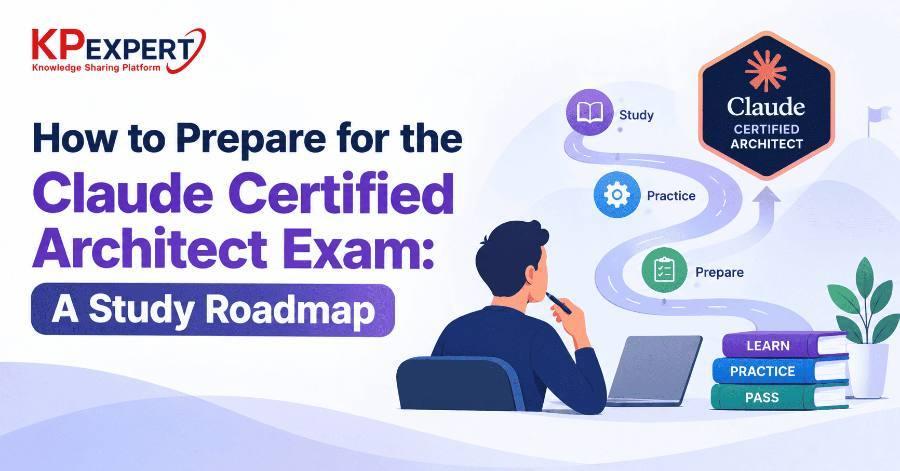
Anthropic launched the Claude Certified Architect – Foundations (CCA-F) exam on March 12, 2026. It was the company's first official certification. It checks whether you can design and ship production-grade systems with the Claude API, the Claude Agent SDK, Model Context Protocol (MCP), and Claude Code.
This guide is for:
- Developers and solution architects who already build with Claude and want to prove it
- Cloud and DevOps engineers moving into AI architecture roles
- Consultants at partner firms who need certified staff for their company's partner tier
The Foundations exam has 60 scenario-based multiple-choice questions to answer in 2 hours. The passing score is 720 out of 1000. You can take it at a test centre or online with a proctor.
There are now two Architect tracks. Both are offered through the Claude Partner Network and Anthropic Partner Academy, so check your eligibility before you plan a date.
The Five Foundations Domains
Your study time should follow these weights. Agentic architecture alone is more than a quarter of the exam.
.mcp.json, built-in tools, tool descriptionsThe Six Exam Scenarios
Questions are built around realistic production situations:
The Professional exam goes further. It covers seven domains and focuses on integration, evaluation, governance, and knowing when Claude is not the right solution.
You need working coding skills and real Claude experience before day one. The exam tests judgment, and judgment comes from building things. Check yourself against this list:
- Comfortable in Python or TypeScript, including async code and JSON handling
- Have called the Claude Messages API, including system prompts and multi-turn conversations
- Have used tool use (function calling) and handled tool results
- Have installed and used Claude Code on a real repository
- Understand REST APIs, environment variables and basic CI/CD (for example, GitHub Actions)
- Know basic cloud architecture: queues, retries, rate limits and logging
Plan for 8 to 10 hours a week, which works out to about 1 hour on weekdays plus a longer weekend session. Each week ends with something you have built, not just something you have read.
Focus on the decisions an architect makes, not on syntax. Most questions describe a scenario and ask for the best design choice.
1. Agentic Architecture and Orchestration (27%)
Know when a simple prompt chain is enough and when you need an agent. Understand the agent loop: the model reasons, calls a tool, reads the result, and decides whether to continue. Learn the coordinator–subagent pattern, where one agent splits up the work and gives each subagent only the context it needs. Be ready to explain stopping conditions, how to limit runaway loops, and how to pass results between agents.
2. Claude Code Configuration and Workflows (20%)
Learn the CLAUDE.md hierarchy. A project-level file is shared through version control, while a user-level file in your home directory is personal. Practise custom slash commands, skills, plan mode and permission settings.
For CI/CD, know how to run Claude Code non-interactively in headless mode with the -p flag:
claude -p "Review the changes in this pull request for bugs and security issues. Output a short summary."
3. Prompt Engineering and Structured Output (20%)
Write clear system prompts, use XML tags to separate instructions from data, and add few-shot examples for tricky formats. For structured output, define a JSON schema, validate every response, and retry with the validation error included in the next prompt.
4. Tool Design and MCP Integration (18%)
Good tools have clear names, specific descriptions and tight input schemas. Learn how MCP servers expose tools, resources and prompts, and how .mcp.json configures servers for a project:
{
  "mcpServers": {
    "orders": {
      "command": "python",
      "args": ["orders_server.py"]
    }
  }
}
Know the trade-off between a few broad tools and many narrow ones.
5. Context Management and Reliability (15%)
Understand context window limits, summarization, and retrieval for long documents. Design escalation paths so the agent hands off to a human when its confidence is low or the action is risky. Know how prompt caching cuts cost and latency when the same context is sent repeatedly.
Build one project for each exam scenario. Each project teaches the trade-offs the exam asks about far better than reading does.
Keep all six in one GitHub repository. It doubles as a portfolio when you apply for architect roles.
Start with the official material, then add practice questions. Anthropic Academy hosts free courses that together cover all five domains.
- Official exam guide: read it twice and note the domain weights and scenarios
- Anthropic Academy (anthropic.skilljar.com): free courses such as Building with the Claude API, Introduction to Model Context Protocol, Claude Code in Action and Claude 101
- Claude documentation (docs.claude.com): the reference for tool use, prompt caching, structured output and the Agent SDK
- Anthropic Cookbook on GitHub: working code for agents, tools and retrieval
- MCP documentation (modelcontextprotocol.io): the specification and example servers
- Official practice exam: take it in week 8 under timed conditions
- KP Expert practice tests: scenario-based mock exams for the Foundations and Professional tracks
You have 2 minutes per question. Read each scenario once to understand the goal and a second time to pick out the constraints.
Tips That Help
- Choose the simplest design. Pick the simplest design that meets the requirement. Over-engineered answers are often traps.
- Note the constraints. Cost, latency, security or “no human available” usually decide the right answer.
- Manage your time. Flag long questions, answer the quick ones first, and come back to the flagged ones with the remaining time.
- Check your setup. For online proctoring, test your webcam, microphone and internet connection the day before.
Mistakes to Avoid
How many questions are on the Claude Certified Architect – Foundations exam?
The exam has 60 multiple-choice questions, and you have 2 hours to finish.
What is the passing score?
You need 720 out of 1000.
How much does the exam cost?
The Foundations exam costs $125 per attempt and the Professional exam costs $175 per attempt. Check Anthropic's official page for current prices.
Can anyone take the exam?
Access is currently through the Claude Partner Network and Anthropic Partner Academy. If your company is not a partner, check the official certification page for current eligibility.
How long should I study?
Most working professionals need 6 to 8 weeks at 8 to 10 hours a week, provided they already have hands-on Claude experience.
Should I take Foundations or Professional first?
Take Foundations first unless you already lead enterprise Claude deployments. Professional focuses on governance, evaluation and integration at scale.
Is the exam open book?
No. It is proctored, and it tests judgment you build through practice rather than facts you can look up.
Passing the Claude Certified Architect exam comes down to three habits: study by domain weight, build one project per scenario, and practise under timed conditions. Follow the 8-week plan above and you will walk into the exam with real experience, not just notes.
Recap: what to take away
- The Foundations exam has 60 questions in 2 hours, and you need 720 out of 1000 to pass
- Spend the most time on agentic architecture (27%), then Claude Code and prompt engineering (20% each)
- Build one hands-on project for each of the six exam scenarios
- Use headless mode for CI/CD, and choose the simplest design that meets the requirement
- Finish with timed practice exams and fix your weakest domain
Ready to start? KP Expert offers scenario-based prep courses for the Claude Certified Architect – Foundations and Professional exams, with practice tests mapped to every domain. Explore the courses at KP Expert.