|
Exadata Network Architecture Series
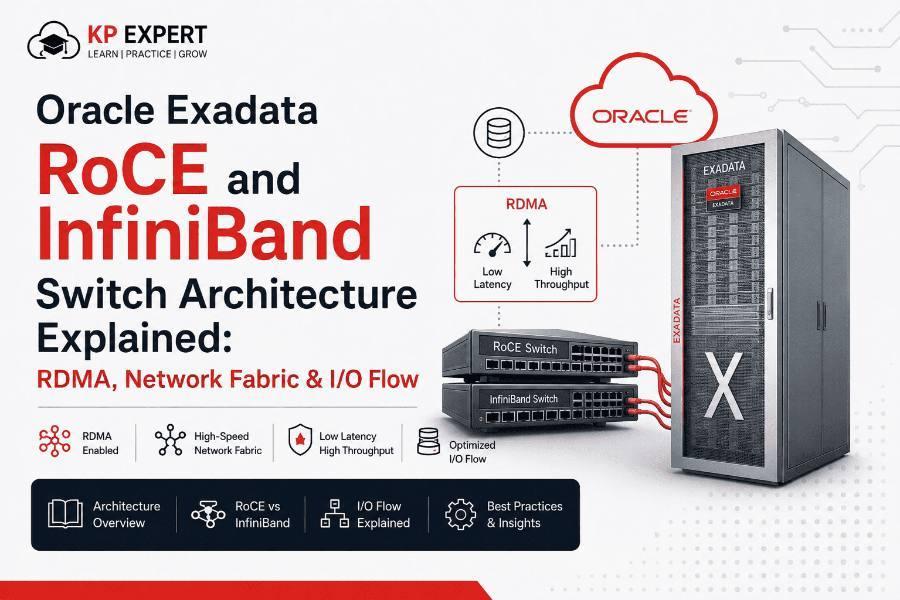
Oracle Exadata RoCE and InfiniBand Switch Architecture Explained
RDMA, Network Fabric & I/O Flow
|
|
|
Oracle Exadata is engineered to provide high-performance database processing by combining database servers, intelligent storage servers, high-speed networking, and specialized Exadata System Software. The network fabric is a critical part of this architecture because database servers and storage servers exchange large volumes of data and database I/O requests.
|
Two important technologies associated with Exadata networking are InfiniBand and RoCE (RDMA over Converged Ethernet). Earlier generations of Exadata relied heavily on InfiniBand for the high-speed private network, while newer Exadata platforms use Ethernet-based networking with RoCE capabilities.
The fundamental idea remains similar: provide a low-latency, high-bandwidth path between database servers and storage servers while supporting RDMA (Remote Direct Memory Access) and intelligent database I/O.
Understanding the Oracle Exadata RoCE and InfiniBand Switch Architecture helps Oracle DBAs, Exadata administrators, database architects, and infrastructure engineers understand how database traffic travels through the system and why the network fabric is essential to Exadata performance. This article explains the architecture, major components, RDMA, RoCE, InfiniBand, network topology, I/O flow, redundancy, performance considerations, and troubleshooting concepts.
|
What Is the Exadata Network Fabric?
|
The Exadata network fabric is the high-speed communication infrastructure connecting the major components of an Exadata environment.
| Client / Application Network |
|
| ↓ |
|
|
| ↓ |
| High-Speed Network Fabric |
|
| ↓ |
Storage Server 1
CELLSRV → Storage |
|
Storage Server 2
CELLSRV → Storage |
|
The network fabric allows database servers to communicate with storage servers and, depending on the Exadata configuration and generation, supports different categories of traffic.
The key requirements for this network include:
| High bandwidth |
Low latency |
High availability |
| Redundant connectivity |
Efficient database I/O |
RDMA capabilities |
Exadata is designed around a scale-out architecture. As database and storage resources are added, the network fabric must provide sufficient connectivity and bandwidth to support parallel workloads.
|
Oracle Exadata Network Architecture
|
An Exadata environment generally contains several logical network functions rather than one network used for everything.
The major networking areas include:
- Client access network
- Management network
- Private cluster/interconnect network
- Database-to-storage network
The database-to-storage network is especially important for Exadata performance because it carries the communication between database servers and storage servers.
|
| ↓ |
|
| ↓ |
| Database Server 1 |
|
Database Server 2 |
|
| ↓ |
|
| ↓ |
Storage Server 1
CELLSRV → Storage |
|
Storage Server 2
CELLSRV → Storage |
|
The exact physical topology, switch configuration, and supported network technologies depend on the Exadata generation and platform.
|
What Is InfiniBand in Oracle Exadata?
|
InfiniBand is a high-performance networking technology designed for low-latency communication and high-throughput data transfer.
Earlier generations of Oracle Exadata used InfiniBand as the high-speed fabric connecting database servers and storage servers. InfiniBand was particularly suitable for Exadata because database workloads can generate substantial I/O traffic between compute and storage nodes.
Its architectural characteristics include:
| ● Low latency |
● High throughput |
| ● RDMA support |
● Efficient data movement |
| ● Hardware-assisted communication |
● High-speed switch fabrics |
|
| ↓ InfiniBand |
|
| ↓ InfiniBand |
|
Multiple switches and redundant links can be used to provide resilient connectivity.
|
What Is RoCE in Oracle Exadata?
|
RoCE stands for RDMA over Converged Ethernet. It combines the RDMA communication model with Ethernet networking. The objective is to provide efficient, low-latency memory-to-memory communication over an Ethernet fabric without requiring traditional CPU-intensive data-copy operations for every transfer.
Modern Exadata platforms use Ethernet-based networking and RoCE capabilities to provide high-performance communication between system components.
The exact implementation varies by Exadata generation, so architecture documentation for the specific platform should always be consulted when designing or troubleshooting an environment.
|
|
RDMA (Remote Direct Memory Access) is one of the key concepts behind both InfiniBand and RoCE. Traditional network communication often involves multiple interactions between the operating system, CPU, network stack, and memory. RDMA allows a system to transfer data directly between memory regions of communicating systems with significantly less CPU and software-stack involvement.
|
TRADITIONAL DATA TRANSFER
| Application |
| ↓ |
| Operating System |
| ↓ |
| Network Stack |
| ↓ |
| CPU Processing |
| ↓ |
| Network |
| ↓ |
| Remote CPU |
| ↓ |
| Remote Memory |
|
|
RDMA-BASED TRANSFER
| Local Memory |
| ↓ |
| RDMA Network |
| ↓ |
| Remote Memory |
Fewer hops → lower latency → less CPU load
|
This can reduce CPU overhead and latency while improving data-transfer efficiency. For Exadata, RDMA is particularly important because database and storage servers need to exchange I/O information efficiently at high speed.
|
|
Although RoCE and InfiniBand are different technologies, both can support RDMA-based communication.
| Feature |
InfiniBand |
RoCE |
| Network technology |
InfiniBand |
Ethernet |
| RDMA support |
Native |
RDMA over Ethernet |
| Network infrastructure |
InfiniBand switches |
Ethernet / RoCE switches |
| Latency |
Very low |
Very low when properly configured |
| Ethernet compatibility |
No |
Yes |
| Exadata usage |
Earlier generations |
Newer Exadata platforms |
| Traffic design |
Specialized fabric |
Ethernet-based fabric |
| Configuration considerations |
InfiniBand fabric |
Ethernet/RoCE fabric and lossless behavior |
The comparison should not be interpreted as meaning that every Exadata platform supports both technologies simultaneously. Exadata generations have different hardware and networking architectures.
|
Oracle Exadata RoCE Switch Architecture
|
A RoCE-based Exadata environment uses high-speed Ethernet switching to connect database servers and storage servers.
| DB Server 1 |
|
DB Server 2 |
|
DB Server 3 |
|
| ↓↓↓ |
|
| ↓↓↓ |
Storage 1
CELLSRV |
|
Storage 2
CELLSRV |
|
Storage 3
CELLSRV |
|
Redundant network paths are normally used so that the failure of a single component does not isolate a database server or storage server. RoCE networks also require appropriate Ethernet configuration to support reliable, predictable RDMA traffic.
|
Why RoCE Requires Careful Network Configuration
|
RoCE operates over Ethernet, but high-performance RDMA traffic has specific network requirements.
| Traffic prioritization |
Congestion management |
Quality of Service |
| MTU configuration |
Link speeds |
Redundant paths |
| Switch configuration |
Network health |
Firmware compatibility |
A poorly configured Ethernet fabric can negatively affect the performance expected from a RoCE-based architecture. Therefore, Exadata networking should be treated as an integrated engineered-system component rather than as a generic Ethernet network.
|
Exadata InfiniBand Switch Architecture
|
In earlier Exadata architectures, InfiniBand switches formed the high-speed fabric between database servers and storage servers.
|
| ↓ |
| InfiniBand Switch A |
|
InfiniBand Switch B |
|
| ↓ |
|
Redundant switches and links provide multiple communication paths. The architecture allows database servers to access multiple storage cells concurrently, creating a highly parallel storage fabric. This parallelism is important for large database workloads because a query can potentially generate I/O across multiple storage servers rather than depending on one centralized storage device.
|
Database Server to Storage Server Communication
|
The database-to-storage communication path is central to Exadata's performance model.
| SQL Statement |
| ↓ |
| Oracle Database |
| ↓ |
| Execution Plan |
| ↓ |
| Smart I/O Decision |
| ↓ |
| Exadata Network Fabric |
| ↓ |
| RoCE / InfiniBand |
| ↓ |
| Storage Server |
| ↓ |
| CELLSRV |
| ↓ |
| Storage Processing |
| ↓ |
| Relevant Data |
| ↓ |
| Network Fabric |
| ↓ |
| Database Server |
The storage server can perform eligible processing before returning data to the database server. This is one of the fundamental differences between Exadata and conventional storage architectures.
|
Role of iDB in Exadata I/O
|
Exadata uses specialized communication mechanisms for database-to-storage interaction. iDB, or Intelligent Database, is associated with communication between Oracle Database and Exadata Storage Servers for intelligent I/O operations. The database server can send storage requests that contain information allowing the storage server to perform appropriate processing.
The storage server can then:
| 1. Receive the request. |
| 2. Process the request through Exadata System Software. |
| 3. Apply eligible SQL offload operations. |
| 4. Use Storage Index information when applicable. |
| 5. Access the appropriate storage tier. |
| 6. Return the relevant result to the database server. |
This architecture reduces unnecessary data movement.
|
|
RoCE and RDMA provide the high-speed communication foundation, while Exadata software provides database-aware processing. These technologies work at different architectural layers.
| Oracle Database / SQL |
| Smart I/O / SQL Offload |
| iDB Communication |
| RDMA |
| RoCE / Ethernet Fabric |
| RoCE Switch |
| Storage Server / CELLSRV |
| Flash / Disk / XRMEM |
This layered architecture is important when troubleshooting performance because a problem can originate at the database, software, network, switch, or storage layer.
|
How Smart Scan Uses the Exadata Network
|
Smart Scan allows eligible SQL processing to be offloaded to Exadata Storage Servers. For example:
SELECT customer_id, order_total

FROM orders

WHERE region = 'NORTH'

AND order_total > 1000;
|
In a traditional architecture, the database server may need to retrieve a large amount of data and perform filtering locally. With eligible Exadata Smart Scan processing:
| Database Server |
| ↓ Smart I/O Request |
| Network Fabric |
| ↓ |
| Storage Server |
| Storage Index |
|
Data Filtering |
|
Column Filtering |
|
Storage Access |
|
| ↓ |
| Only Relevant Data |
| ↓ |
| Database Server |
This can significantly reduce the amount of data transferred across the network. Oracle's Exadata architecture is designed to offload eligible database operations to storage servers and return relevant results rather than unnecessarily transferring all underlying data.
|
Exadata Storage Servers and CELLSRV
|
The network fabric connects database servers to the intelligent storage layer. At the storage-server side, CELLSRV is the core software component responsible for most storage-server services.
| RoCE / InfiniBand Fabric |
| ↓ |
| Storage Server |
| ↓ |
| CELLSRV |
| Smart Scan |
|
IORM |
|
Storage Indexes |
|
| ↓ |
| Flash / XRMEM / Disk |
This means the network cannot be analyzed independently from Exadata System Software. A database administrator troubleshooting slow I/O should consider both the network path and what CELLSRV is doing with the request.
|
Exadata Network Redundancy
|
High availability is a fundamental design requirement for engineered systems.
| Database Server |
| ↓↓ |
| Network Path A |
|
Network Path B |
|
|
|
| ↘ ↙ |
| Storage Server |
Redundancy helps protect against failures involving:
| Network links |
Switches |
Network interfaces |
| Cabling |
Individual system components |
The actual redundancy design depends on the Exadata generation and hardware architecture.
|
Exadata Network Performance
|
Network performance directly affects database I/O when database servers communicate with storage servers.
| Bandwidth |
Higher available bandwidth allows more data to move concurrently. |
| Latency |
Lower latency reduces the time required to complete communication operations. |
| Congestion |
Network congestion can increase latency and reduce throughput. |
| Packet behavior |
RDMA traffic requires appropriate handling by the Ethernet fabric. |
| Parallelism |
Exadata can distribute I/O across multiple storage servers and network paths. |
The objective is not simply to maximize bandwidth. The complete system must provide balanced performance across CPU, memory, network, and storage resources.
|
RoCE Network Configuration Considerations
|
A RoCE-based architecture requires careful engineering.
MTU
Consistent MTU configuration can help avoid fragmentation and unexpected packet handling. |
Quality of Service
Traffic prioritization can help protect latency-sensitive workloads. |
Congestion Management
RoCE networks must be engineered to manage congestion appropriately. |
Redundancy
Multiple paths should be available according to the supported Exadata topology. |
Firmware Compatibility
Switch, server, adapter, and Exadata software versions must be maintained per Oracle's supported configurations. |
Monitoring
Network metrics should be correlated with database and storage metrics rather than evaluated in isolation. |
|
InfiniBand Network Configuration Considerations
|
InfiniBand environments have their own management and operational requirements. DBAs and infrastructure teams should monitor:
| Link status |
Port health |
Switch health |
| Fabric topology |
Error counters |
Link failures |
| Hardware alerts |
Firmware levels |
Network utilization |
A healthy InfiniBand fabric is essential for maintaining predictable database-to-storage communication.
|
Exadata Network Monitoring and Troubleshooting
|
When diagnosing an Exadata performance issue, avoid assuming that the database or storage is automatically responsible. A structured troubleshooting approach is better.
| STEP 1 • Check database performance |
| Review: Database wait events, SQL execution statistics, I/O latency, CPU usage, Execution plans. |
| STEP 2 • Check Smart Scan activity |
| Determine whether the SQL is using eligible offload processing. |
| STEP 3 • Check storage performance |
| Review: Storage-server metrics, I/O latency, Flash utilization, CELLSRV health, Storage alerts. |
| STEP 4 • Check network performance |
| Investigate: Link status, Errors, Congestion, Packet drops, Throughput, Latency. |
| STEP 5 • Check switch health |
| A network switch issue can affect multiple database and storage servers simultaneously. |
| STEP 6 • Correlate timestamps |
| Database, storage, and network events should be correlated by time to identify the actual source of the problem. |
|
Common Exadata RoCE and InfiniBand Architecture Mistakes
|
Mistake 1 — Treating RoCE as ordinary Ethernet
RoCE uses Ethernet infrastructure, but its performance characteristics and configuration requirements are specialized.
|
Mistake 2 — Assuming RoCE and InfiniBand are interchangeable
Both can support RDMA, but they use different networking technologies and require different infrastructure.
|
Mistake 3 — Ignoring network congestion
High bandwidth does not automatically eliminate congestion-related latency.
|
Mistake 4 — Looking only at network throughput
Low throughput may be a symptom rather than the root cause. Database workload, storage latency, SQL execution, or IORM policies may contribute.
|
Mistake 5 — Ignoring Exadata generation
Network architecture changes between Exadata generations. Always verify hardware and software documentation for the specific platform.
|
Mistake 6 — Troubleshooting the network separately from Exadata
The database, network fabric, storage server, and Exadata System Software operate as an integrated system.
|
|
RoCE and InfiniBand in Exadata: Key Differences
|
The most important architectural distinction is the underlying network fabric.
| InfiniBand |
| ↓ |
| InfiniBand Fabric |
| ↓ |
| RDMA |
| ↓ |
| Database ↔ Storage |
|
|
| RoCE |
| ↓ |
| Ethernet Fabric |
| ↓ |
| RDMA |
| ↓ |
| Database ↔ Storage |
|
RoCE provides RDMA capabilities over Ethernet, while InfiniBand is a dedicated high-performance networking technology with native RDMA capabilities. For modern Exadata deployments, the exact network technology should be determined from the supported hardware architecture rather than assumed from older Exadata documentation.
|
Benefits of the Exadata Network Architecture
|
The combination of high-speed networking, RDMA, intelligent storage, and database-aware software provides several benefits.
⚡ High throughput
Multiple database and storage servers can communicate concurrently. |
⚡ Low latency
RDMA-based communication reduces communication overhead. |
⚡ Reduced CPU overhead
RDMA can reduce the amount of CPU processing involved in data movement. |
⚡ Efficient I/O
Database requests can be processed closer to the data. |
⚡ SQL offload
Eligible operations can execute on storage servers. |
⚡ Scale-out architecture
Additional resources can participate in parallel processing. |
⚡ High availability
Redundant network paths and components help protect against infrastructure failures. |
|
Best Practices for Exadata RoCE and InfiniBand Networking
|
| 1Follow Oracle's supported hardware topology. |
| 2Use supported Exadata System Software and firmware versions. |
| 3Maintain consistent network configuration across the fabric. |
| 4Monitor network errors and congestion. |
| 5Monitor database, storage, and network metrics together. |
| 6Validate redundancy and failover paths. |
| 7Understand the Exadata generation before troubleshooting. |
| 8Avoid treating RoCE as a generic Ethernet workload. |
| 9Use Smart Scan and SQL offload capabilities where applicable. |
| 10Document network topology and dependencies. |
|
Frequently Asked Questions
|
|
Q. What is RoCE in Oracle Exadata?
RoCE stands for RDMA over Converged Ethernet. It provides RDMA capabilities over Ethernet and is used in newer Exadata networking architectures to support high-speed communication.
|
|
Q. What is InfiniBand in Oracle Exadata?
InfiniBand is a high-performance networking technology used in earlier Exadata generations for communication between database servers and storage servers.
|
|
Q. What is RDMA?
RDMA stands for Remote Direct Memory Access. It allows data to be transferred between memory locations on networked systems with reduced involvement from the CPU and operating-system networking stack.
|
|
Q. Is Oracle Exadata using RoCE or InfiniBand?
This depends on the Exadata generation and platform. Earlier Exadata systems used InfiniBand extensively, while newer platforms use Ethernet-based networking with RoCE capabilities.
|
|
Q. What is the Exadata network fabric?
The Exadata network fabric is the high-speed infrastructure connecting database servers and storage servers. It provides the communication path required for database I/O and intelligent storage operations.
|
|
Q. What is the role of the RoCE switch in Exadata?
The RoCE switch provides Ethernet-based high-speed connectivity between Exadata components in architectures using RoCE. It forms part of the network fabric through which RDMA-enabled communication can occur.
|
|
Q. Does Smart Scan depend on RoCE?
Smart Scan is an Exadata software capability, while RoCE is a networking technology. RoCE provides the underlying communication infrastructure in supported modern Exadata platforms; Smart Scan performs eligible SQL processing at the storage layer.
|
|
Q. Why is RDMA important in Exadata?
RDMA enables efficient memory-to-memory data transfer with reduced CPU and software-stack overhead. This is valuable for high-volume, low-latency database-to-storage communication.
|
|
Q. How does Exadata reduce network traffic?
Exadata can reduce unnecessary data movement through capabilities such as Smart Scan and Storage Indexes. Eligible filtering and other processing can occur at the storage server before relevant results are returned to the database server.
|
|
|
The Oracle Exadata RoCE and InfiniBand Switch Architecture is a fundamental part of Exadata's high-performance database design. The network fabric connects database servers with intelligent storage servers and provides the communication path required for high-speed database I/O.
InfiniBand played an important role in earlier Exadata generations, while newer Exadata platforms use Ethernet-based architectures incorporating RoCE and RDMA. Although the underlying networking technology has evolved, the architectural objective remains consistent: provide high bandwidth, low latency, scalable connectivity, and efficient communication between database and storage resources.
The complete Exadata performance model depends on several layers working together:
| Oracle Database |
| Smart I/O / SQL Offload |
| iDB |
| RDMA |
| RoCE / InfiniBand Fabric |
| Switch |
| Storage Server |
| CELLSRV |
| Flash / XRMEM / Disk |
Understanding this complete path helps Oracle DBAs and infrastructure professionals diagnose performance problems more accurately. A slow database operation may involve SQL execution, storage processing, network congestion, switch behavior, or hardware configuration rather than a single isolated component.
For professionals working with Oracle Exadata, knowledge of RoCE, InfiniBand, RDMA, network fabrics, Smart I/O, CELLSRV, and database-to-storage I/O flow provides a strong foundation for Exadata administration, performance tuning, architecture design, and troubleshooting.
|
|
KP EXPERT • ORACLE EXADATA ARCHITECTURE SERIES
|